Liquid Thermo Shield: KillGlass
Sunlight Ultraviolet & Infrared Heat Protection
Advanced Glass Nano Coating
KillGlass Key Benefits
Ultraviolet (UV) Blocking:
Essential to stop Ultraviolet, commonly know as UV damaging surfaces and causing fading in carpets, soft furnishing and plastics.
In the winter UV levels are actually the same if not higher than in the summer months because the Infrared (IR) levels are reduced.
Infrared (IR) Blocking:
Stops infrared light, commonly known as (IR) heating buildings, vehicles and boats and making the environment uncomfortable. This also allows Air Conditioning systems to work more effectively which saves money.
Heat Reduction:
On hot days the temperature is reduced in rooms, vehicles and boats and in winter the coating stops heat escaping through the glass therefore reducing energy costs.
Crystal Clear:
KillGlass Clear coating is virtually invisible so keeps glass surfaces looking sharp.
Optional Tinting:
KillGlass Tint gives a light Bronzing/Iridium Blue to the glass surface while maintaining sharp focus and clarity.
Interior and Exterior:
KillGlass can be applied to either side of the glass surface, especially useful if access is limited.
Abrasion Resistant:
KillGlass coatings are really tough and reduce abrasion and scratches, especially useful on polycarbonate and plastic panels. There’s no peeling, stickiness or distortion unlike “stick-on” window films.
Weather Proof:
KillGlass coatings have been tested in all weather conditions and function even in the most extreme locations.
Coating Hardness:
KillGlass Hardness is based on the Mohs scale of mineral hardness. KillGlass coatings are rated between 8-9H.

Actual Test Results Of KillGlass – Tinted / Clear
| Uncoated Float Glass (3mm) | LTS KillGlass (Tint) | LTS KillGlass (Clear) | |
| Visible Transmittance (VT) % | 90 % | 70.4 % | 87 % |
| Total Solar Absorption (A) % | 6 % | 60.7 % | 47.4 % |
| Total Solar Reflection (R) % | 8 % | 5.3 % | 6.1 % |
| Total Solar Transmission (T) % | 86 % | 34 % | 46.6 % |
| Infrared Reflection (IR) % | 16 % | 90 % | 60 % |
| Ultraviolet Rejection (UV) % | 29 % | 99.9 % | 99.9 % |
| American Values: Solar Heat Gain Coefficient (SHGC) | 0.88 | 0.46 | 0.63 |
| Shading Coefficient (SC) | 1 | 0.64 | 0.72 |
| Convected / Reradiated Absorbed Heat (C) | 2 % | 12 % | 16.4 % |
| Selectivity index (S): Light to Heat ratio | 1.02 | 1.53 | 1.38 |
| European Values: Solar Factor (g value) Total Energy Transmittance (TET) Zonnetoetredingsfactor (ZTA) | 0.88 | 0.46 | 0.63 |
U Value Calculation Method
The Effective U Value, or energy balance value, is a revised U value allowing for Solar Gain. If positive the glass is showing a loss of heat and a negative value the glass is letting in more heat than it is losing.
- This calculator is based upon EN ISO 14438:2002, ‘Glass in building. Determination of energy balance value. Calculation method’
- BS EN 673, ‘Glass in building. Determination of thermal transmittance (U value). Calculation method’;
- ISO 9050:2003, ‘Glass in building. Determination of light transmittance, solar direct transmittance, total solar energy transmittance, ultraviolet transmittance and related glazing factors’;
Further information: The calculation is based on the centre pane performance of the glazing in terms of U value and g value (also known as total solar heat transmittance or solar factor), which is available for each glass product from the glass manufacturers or supplier. The resultant value is independent of the framing or the dimensions of the unit – unlike Window Energy Ratings, which calculate window performance on the basis of a theoretical window configuration with all locations within the UK in one value and all orientations – which may not be representative of the dimensions installed or the location and aspect of the building.
KillGlass Results Explained
Visible Transmittance (VT): Is a fraction of the visible spectrum of sunlight (380 to 720 nanometers), weighted by the sensitivity of the human eye, that is transmitted through the glazing of a window. A higher VT transmits more visible light. VT is expressed as a number between 0 and 1. The VT you need for a window should be determined by your Office or Home’s daylighting requirements and/or whether you need to reduce interior glare in a space.
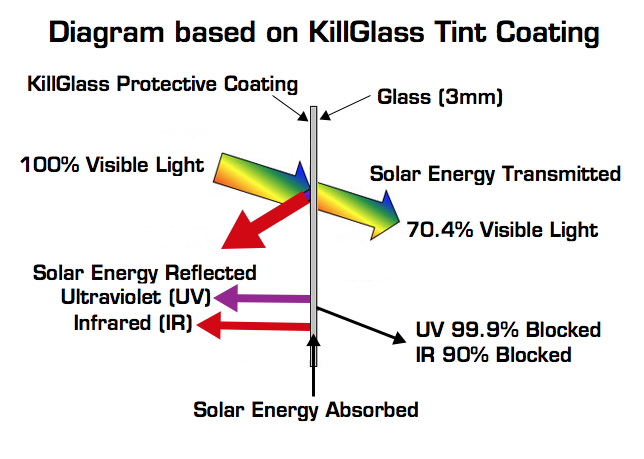
Total Solar Absorption (%): This is solar energy absorbed by KillGlass. (60.7%)
Total Solar Reflection (%): This Is solar energy reflected by KillGlass. (5.3%)
Total Solar Transmission (%): This is solar energy transmitted through KillGlass. (34%)
Note: Total Solar Energy 100% = Absorbed % + Reflected % + Transmitted %
Solar Heat Gain Coefficient (SHGC) : Is the fraction of solar radiation admitted through a window, either transmitted directly and/or absorbed, and subsequently released as heat inside an Office or Home. The lower the SHGC, the less solar heat it transmits and the greater its shading ability. The SHGC is expressed as a dimensionless number from 0 to 1. A high (>1) coefficient signifies high heat gain, while a low (0<) coefficient means low heat gain. In our tinted test of KillGlass the SHGC was 0.46, which means it's more or less in the middle of high heat gain & low heat gain. The larger the SHGC value, the greater the „solar gain‟. Shading Coefficient (SC): Window standards are now moving away from a previous standard referred to as Shading Coefficient (SC) to Solar Heat Gain Coefficient (SHGC), which is defined as that fraction of incident solar radiation that actually enters a building through the entire window assembly as heat gain. To perform an approximate conversion from SC to SHGC, multiply the SC value by 0.87.

Solar Energy Explained - Reflected / Absorbed / Transmitted
When the sun’s radiation reaches the glass surface, part of this energy is reflected by the glass: This is the RE, or Reflected Energy. Another part of the sun’s radiation passes directly through the glass: This is the TE, or Transmitted Energy. The last sun energy component is absorbed by the glass. This is the AE, or absorbed energy. It is important to note that this energy will also either reflected or transmitted through the glass.
TE and RE measurements are generally made using a method called Parry Moon/mass 2. This method covers the 300 to 2140 nm wavelength, ensuring the value represents the best average.
Why is Ultraviolet (UV) damaging
Ultraviolet (UV) light is largely responsible for the fading of colours and degeneration of many materials. KillGlass protective coating reduces the damaging rays by up to 99.9% and can therefore substantially slow down or eliminate the fading process. KillGlass protective coating can also be extremely useful in protecting displays in shop windows, galleries, and furniture, prolonging the life and maintaining their original colour.
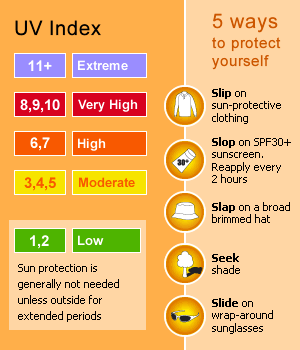
Cancer Research UK – Sun Smart

99.9%
KillGlass Tint UV Protection
90%
KillGlass Tint IR Protection
99.9%
KillGlass Clear UV Protection
60%
KillGlass Clear IR Protection
Liquid Thermo Shield
Building 1000
Lakeside North Harbour
Portsmouth
Hampshire
PO6 3EN
United Kingdom
+44 (0) 7398 117651